Quantum Information 2 Volume Set From Foundations to Quantum Technology Applications Book Review

Quantum computing is a type of computation that harnesses the collective properties of breakthrough states, such as superposition, interference, and entanglement, to perform calculations. The devices that perform quantum computations are known as quantum computers.[1] : I-5 Though current quantum computers are also pocket-size to outperform usual (classical) computers for applied applications, they are believed to exist capable of solving certain computational issues, such as integer factorization (which underlies RSA encryption), substantially faster than classical computers.[ii] The report of quantum computing is a subfield of quantum information science.
In that location are several types of quantum computers (also known as quantum computing systems), including the quantum circuit model, quantum Turing motorcar, adiabatic quantum reckoner, ane-style quantum computer, and various quantum cellular automata. The most widely used model is the quantum excursion, based on the quantum scrap, or "qubit", which is somewhat analogous to the bit in classical computation. A qubit can be in a 1 or 0 quantum country, or in a superposition of the 1 and 0 states. When it is measured, however, it is always 0 or 1; the probability of either effect depends on the qubit'due south breakthrough state immediately prior to measurement.
Efforts towards edifice a physical quantum estimator focus on technologies such as transmons, ion traps and topological quantum computers, which aim to create high-quality qubits.[one] : 2–13 These qubits may be designed differently, depending on the full breakthrough estimator's computing model, as to whether quantum logic gates, breakthrough annealing, or adiabatic quantum computation are employed. There are currently a number of significant obstacles to constructing useful quantum computers. It is specially hard to maintain qubits' breakthrough states, every bit they suffer from breakthrough decoherence and state allegiance. Quantum computers therefore require error correction.[iii] [iv]
As of 2022, quantum computing is a loftier-profile research and evolution action in academic institutions and the private sector around the globe. A Dec 2021 McKinsey & Company analysis states that "..investment dollars are pouring in, and quantum-calculating beginning-ups are proliferating". They become on to note that "While quantum computing promises to help businesses solve problems that are beyond the achieve and speed of conventional high-operation computers, employ cases are largely experimental and hypothetical at this early stage."[5]
Any computational problem that can exist solved past a classical estimator can also be solved by a quantum figurer.[6] Conversely, any problem that can exist solved by a quantum estimator can too be solved past a classical computer, at least in principle given enough time. In other words, quantum computers obey the Church–Turing thesis. This means that while breakthrough computers provide no additional advantages over classical computers in terms of computability, quantum algorithms for sure problems accept significantly lower time complexities than corresponding known classical algorithms. Notably, quantum computers are believed to be able to quickly solve certain problems that no classical computer could solve in any feasible corporeality of time—a feat known as "quantum supremacy." The study of the computational complexity of issues with respect to quantum computers is known as quantum complexity theory.
History [edit]
Breakthrough calculating began in 1980 when physicist Paul Benioff proposed a breakthrough mechanical model of the Turing motorcar.[7] Richard Feynman and Yuri Manin later suggested that a quantum computer had the potential to simulate things a classical calculator could non feasibly do.[8] [9] In 1986 Feynman introduced an early on version of the quantum circuit notation.[10] In 1994, Peter Shor developed a breakthrough algorithm for finding the prime factors of an integer with the potential to decrypt RSA-encrypted communications.[11] In 1998 Isaac Chuang, Neil Gershenfeld and Mark Kubinec created the kickoff two-qubit breakthrough reckoner that could perform computations.[12] [xiii] Despite ongoing experimental progress since the tardily 1990s, most researchers believe that "mistake-tolerant breakthrough computing [is] still a rather distant dream."[14] In contempo years, investment in quantum computing research has increased in the public and private sectors.[xv] [sixteen] On 23 Oct 2019, Google AI, in partnership with the U.S. National Aeronautics and Space Administration (NASA), claimed to take performed a breakthrough computation that was infeasible on whatever classical calculator,[17] [xviii] just whether this claim was or is still valid is a topic of active enquiry.[xix] [20]
Quantum circuit [edit]
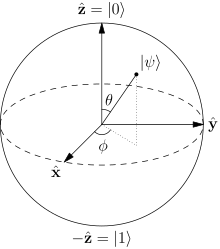
The Bloch sphere is a representation of a qubit, the fundamental building block of quantum computers.
Definition [edit]
The prevailing model of breakthrough ciphering describes the ciphering in terms of a network of quantum logic gates.[21] This model is a complex linear-algebraic generalization of boolean circuits.[22]
A memory consisting of bits of information has possible states. A vector representing all memory states thus has entries (one for each state). This vector is viewed as a probability vector and represents the fact that the memory is to be found in a particular state.


In the classical view, one entry would accept a value of 1 (i.east. a 100% probability of existence in this country) and all other entries would exist goose egg.
In quantum mechanics, probability vectors tin be generalized to density operators. The breakthrough state vector formalism is ordinarily introduced first because it is conceptually simpler, and because information technology can be used instead of the density matrix formalism for pure states, where the whole quantum system is known.
We brainstorm by considering a uncomplicated memory consisting of only one bit. This memory may be institute in ane of two states: the naught state or the 1 state. We may represent the state of this memory using Dirac notation so that
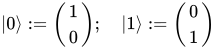
A breakthrough retentiveness may then exist establish in any breakthrough superposition of the two classical states and :



The coefficients and are complex numbers. I qubit of data is said to exist encoded into the quantum memory. The state is not itself a probability vector but can be connected with a probability vector via a measurement operation. If the quantum retention is measured to decide whether the state is or (this is known as a computational footing measurement), the zero state would be observed with probability and the one state with probability . The numbers and are called probability amplitudes.


The state of this one-qubit quantum memory tin can be manipulated by applying quantum logic gates, analogous to how classical retentiveness tin be manipulated with classical logic gates. One of import gate for both classical and quantum computation is the NOT gate, which can be represented by a matrix
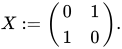
Mathematically, the application of such a logic gate to a quantum state vector is modelled with matrix multiplication. Thus and .


The mathematics of single qubit gates can be extended to operate on multi-qubit quantum memories in two important ways. One fashion is simply to select a qubit and apply that gate to the target qubit whilst leaving the remainder of the memory unaffected. Another way is to use the gate to its target simply if another office of the memory is in a desired state. These two choices can be illustrated using another example. The possible states of a two-qubit quantum memory are

The CNOT gate can so exist represented using the following matrix:
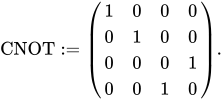
Equally a mathematical consequence of this definition, , , , and . In other words, the CNOT applies a Non gate ( from earlier) to the second qubit if and only if the beginning qubit is in the country . If the first qubit is , nothing is washed to either qubit.





In summary, a breakthrough computation can be described as a network of breakthrough logic gates and measurements. However, any measurement can be deferred to the end of breakthrough computation, though this deferment may come at a computational cost, and so most quantum circuits depict a network consisting only of breakthrough logic gates and no measurements.
Any quantum computation (which is, in the above formalism, whatsoever unitary matrix over qubits) can exist represented as a network of quantum logic gates from a fairly small family of gates. A pick of gate family that enables this structure is known as a universal gate fix, since a computer that tin run such circuits is a universal quantum computer. I mutual such set includes all unmarried-qubit gates also every bit the CNOT gate from above. This ways any breakthrough computation can be performed by executing a sequence of single-qubit gates together with CNOT gates. Though this gate set is infinite, it can be replaced with a finite gate ready past highly-seasoned to the Solovay-Kitaev theorem.

Quantum algorithms [edit]
Progress in finding breakthrough algorithms typically focuses on this breakthrough circuit model, though exceptions like the breakthrough adiabatic algorithm exist. Quantum algorithms can be roughly categorized by the type of speedup achieved over respective classical algorithms.[23]
Quantum algorithms that offer more than than a polynomial speedup over the best known classical algorithm include Shor's algorithm for factoring and the related quantum algorithms for computing discrete logarithms, solving Pell's equation, and more mostly solving the hidden subgroup problem for abelian finite groups.[23] These algorithms depend on the primitive of the quantum Fourier transform. No mathematical proof has been found that shows that an equally fast classical algorithm cannot exist discovered, although this is considered unlikely.[24] [ self-published source? ] Certain oracle problems like Simon'south problem and the Bernstein–Vazirani problem do requite provable speedups, though this is in the breakthrough query model, which is a restricted model where lower bounds are much easier to prove and doesn't necessarily interpret to speedups for applied bug.
Other problems, including the simulation of quantum concrete processes from chemistry and solid-state physics, the approximation of certain Jones polynomials, and the breakthrough algorithm for linear systems of equations have quantum algorithms appearing to give super-polynomial speedups and are BQP-complete. Because these bug are BQP-complete, an equally fast classical algorithm for them would imply that no quantum algorithm gives a super-polynomial speedup, which is believed to be unlikely.[25]
Some breakthrough algorithms, like Grover'due south algorithm and aamplitude distension, give polynomial speedups over corresponding classical algorithms.[23] Though these algorithms give comparably small quadratic speedup, they are widely applicative and thus give speedups for a wide range of problems.[26] Many examples of provable quantum speedups for query problems are related to Grover's algorithm, including Brassard, Høyer, and Tapp'southward algorithm for finding collisions in two-to-one functions,[27] which uses Grover'due south algorithm, and Farhi, Goldstone, and Gutmann's algorithm for evaluating NAND trees,[28] which is a variant of the search problem.
Potential applications [edit]
Cryptography [edit]
A notable awarding of quantum computation is for attacks on cryptographic systems that are currently in use. Integer factorization, which underpins the security of public central cryptographic systems, is believed to be computationally infeasible with an ordinary calculator for large integers if they are the product of few prime number numbers (e.one thousand., products of two 300-digit primes).[29] By comparison, a breakthrough computer could efficiently solve this trouble using Shor's algorithm to discover its factors. This power would let a quantum computer to pause many of the cryptographic systems in employ today, in the sense that there would be a polynomial fourth dimension (in the number of digits of the integer) algorithm for solving the trouble. In particular, most of the popular public fundamental ciphers are based on the difficulty of factoring integers or the detached logarithm problem, both of which can be solved by Shor's algorithm. In particular, the RSA, Diffie–Hellman, and elliptic curve Diffie–Hellman algorithms could be cleaved. These are used to protect secure Spider web pages, encrypted email, and many other types of data. Breaking these would have meaning ramifications for electronic privacy and security.
Identifying cryptographic systems that may be secure against breakthrough algorithms is an actively researched topic nether the field of post-quantum cryptography.[30] [31] Some public-key algorithms are based on problems other than the integer factorization and detached logarithm problems to which Shor's algorithm applies, like the McEliece cryptosystem based on a problem in coding theory.[30] [32] Lattice-based cryptosystems are also not known to be broken past quantum computers, and finding a polynomial time algorithm for solving the dihedral hidden subgroup trouble, which would break many lattice based cryptosystems, is a well-studied open up problem.[33] It has been proven that applying Grover's algorithm to break a symmetric (secret key) algorithm past creature forcefulness requires time equal to roughly 2 north/2 invocations of the underlying cryptographic algorithm, compared with roughly 2 n in the classical example,[34] meaning that symmetric key lengths are effectively halved: AES-256 would have the same security against an attack using Grover's algorithm that AES-128 has against classical brute-forcefulness search (see Primal size).
Quantum cryptography could potentially fulfill some of the functions of public key cryptography. Breakthrough-based cryptographic systems could, therefore, be more secure than traditional systems against breakthrough hacking.[35]
Search problems [edit]
The most well-known example of a trouble albeit a polynomial quantum speedup is unstructured search, finding a marked item out of a list of items in a database. This can be solved past Grover's algorithm using queries to the database, quadratically fewer than the queries required for classical algorithms. In this case, the advantage is not merely provable simply also optimal: it has been shown that Grover's algorithm gives the maximal possible probability of finding the desired chemical element for any number of oracle lookups.


Problems that tin can exist efficiently addressed with Grover's algorithm have the post-obit properties:[36] [37]
- At that place is no searchable structure in the drove of possible answers,
- The number of possible answers to check is the same as the number of inputs to the algorithm, and
- In that location exists a boolean function that evaluates each input and determines whether it is the correct answer
For problems with all these properties, the running time of Grover's algorithm on a quantum computer scales as the square root of the number of inputs (or elements in the database), as opposed to the linear scaling of classical algorithms. A general class of problems to which Grover's algorithm tin can be practical[38] is Boolean satisfiability trouble, where the database through which the algorithm iterates is that of all possible answers. An case and possible awarding of this is a password cracker that attempts to approximate a password. Breaking symmetric ciphers with this algorithm is of interest of government agencies.[39]
Simulation of breakthrough systems [edit]
Since chemical science and nanotechnology rely on understanding quantum systems, and such systems are impossible to simulate in an efficient manner classically, many[ who? ] believe quantum simulation will be i of the near important applications of breakthrough computing.[40] Quantum simulation could also exist used to simulate the behavior of atoms and particles at unusual conditions such as the reactions inside a collider.[41] Quantum simulations might exist used to predict future paths of particles and protons under superposition in the double-slit experiment.[ citation needed ] About 2% of the annual global energy output is used for nitrogen fixation to produce ammonia for the Haber process in the agricultural fertilizer industry while naturally occurring organisms besides produce ammonia. Quantum simulations might be used to understand this process increasing product.[42]
Breakthrough annealing and adiabatic optimization [edit]
Breakthrough annealing or Adiabatic breakthrough computation relies on the adiabatic theorem to undertake calculations. A organisation is placed in the footing country for a simple Hamiltonian, which is slowly evolved to a more complicated Hamiltonian whose ground state represents the solution to the trouble in question. The adiabatic theorem states that if the evolution is dull plenty the system will stay in its ground state at all times through the process.
Auto learning [edit]
Since quantum computers tin can produce outputs that classical computers cannot produce efficiently, and since breakthrough computation is fundamentally linear algebraic, some limited hope in developing quantum algorithms that can speed upwardly car learning tasks.[43] [44] For instance, the quantum algorithm for linear systems of equations, or "HHL Algorithm", named after its discoverers Harrow, Hassidim, and Lloyd, is believed to provide speedup over classical counterparts.[45] [44] Some research groups have recently explored the employ of breakthrough annealing hardware for training Boltzmann machines and deep neural networks.[46] [47] [48]
Computational biology [edit]
In the field of computational biology, breakthrough computing has played a big role in solving many biological issues. One of the well-known examples would exist in computational genomics and how computing has drastically reduced the time to sequence a human genome. Given how computational biology is using generic data modeling and storage, its applications to computational biology are expected to arise besides.[49]
Computer-aided drug design and generative chemical science [edit]
Deep generative chemistry models emerge as powerful tools to expedite drug discovery. However, the immense size and complexity of the structural space of all possible drug-similar molecules pose meaning obstacles, which could be overcome in the future by quantum computers. Breakthrough computers are naturally good for solving complex breakthrough many-body problems[fifty] and thus may be instrumental in applications involving quantum chemistry. Therefore, i tin expect that quantum-enhanced generative models[51] including quantum GANs[52] may eventually be adult into ultimate generative chemistry algorithms. Hybrid architectures combining quantum computers with deep classical networks, such as Quantum Variational Autoencoders, tin can already exist trained on commercially bachelor annealers and used to generate novel drug-like molecular structures.[53]
Developing physical breakthrough computers [edit]
Challenges [edit]
There are a number of technical challenges in building a large-scale quantum computer.[54] Physicist David DiVincenzo has listed these requirements for a practical quantum computer:[55]
- Physically scalable to increase the number of qubits
- Qubits that can be initialized to arbitrary values
- Quantum gates that are faster than decoherence time
- Universal gate set
- Qubits that can be read hands
Sourcing parts for quantum computers is besides very hard. Many breakthrough computers, like those constructed past Google and IBM, need helium-3, a nuclear enquiry byproduct, and special superconducting cables made only by the Japanese company Coax Co.[56]
The control of multi-qubit systems requires the generation and coordination of a big number of electric signals with tight and deterministic timing resolution. This has led to the development of quantum controllers which enable interfacing with the qubits. Scaling these systems to support a growing number of qubits is an boosted challenge.[57]
Breakthrough decoherence [edit]
Ane of the greatest challenges involved with constructing breakthrough computers is controlling or removing quantum decoherence. This ordinarily ways isolating the system from its surround as interactions with the external world cause the system to decohere. Still, other sources of decoherence also exist. Examples include the quantum gates, and the lattice vibrations and background thermonuclear spin of the concrete arrangement used to implement the qubits. Decoherence is irreversible, every bit it is effectively non-unitary, and is unremarkably something that should be highly controlled, if not avoided. Decoherence times for candidate systems in particular, the transverse relaxation time T 2 (for NMR and MRI technology, also called the dephasing time), typically range between nanoseconds and seconds at low temperature.[58] Currently, some breakthrough computers crave their qubits to be cooled to 20 millikelvin (usually using a dilution refrigerator[59]) in order to prevent pregnant decoherence.[sixty] A 2020 study argues that ionizing radiation such as cosmic rays can even so cause certain systems to decohere within milliseconds.[61]
As a issue, time-consuming tasks may render some breakthrough algorithms inoperable, as maintaining the country of qubits for a long enough elapsing will eventually corrupt the superpositions.[62]
These bug are more hard for optical approaches as the timescales are orders of magnitude shorter and an often-cited approach to overcoming them is optical pulse shaping. Error rates are typically proportional to the ratio of operating fourth dimension to decoherence fourth dimension, hence any operation must be completed much more quickly than the decoherence time.
As described in the Quantum threshold theorem, if the error rate is small enough, information technology is thought to be possible to use quantum error correction to suppress errors and decoherence. This allows the full calculation time to be longer than the decoherence fourth dimension if the fault correction scheme tin can right errors faster than decoherence introduces them. An oftentimes cited effigy for the required error rate in each gate for mistake-tolerant ciphering is x−3, assuming the noise is depolarizing.
Meeting this scalability condition is possible for a wide range of systems. Still, the employ of error correction brings with it the toll of a greatly increased number of required qubits. The number required to gene integers using Shor's algorithm is still polynomial, and thought to exist between L and L two, where L is the number of digits in the number to be factored; error correction algorithms would inflate this figure by an additional factor of Fifty. For a k-bit number, this implies a need for about 10four bits without error correction.[63] With mistake correction, the effigy would rise to about x7 bits. Computation fourth dimension is near L 2 or about 107 steps and at 1 MHz, about 10 seconds.
A very unlike approach to the stability-decoherence problem is to create a topological quantum calculator with anyons, quasi-particles used as threads and relying on complect theory to form stable logic gates.[64] [65]
Quantum supremacy [edit]
Breakthrough supremacy is a term coined by John Preskill referring to the engineering feat of demonstrating that a programmable quantum device can solve a problem beyond the capabilities of country-of-the-fine art classical computers.[66] [67] [68] The problem need not be useful, and so some view the quantum supremacy exam only as a potential future criterion.[69]
In October 2019, Google AI Breakthrough, with the help of NASA, became the showtime to claim to accept achieved quantum supremacy by performing calculations on the Sycamore breakthrough reckoner more than iii,000,000 times faster than they could be done on Pinnacle, generally considered the earth's fastest computer.[70] [71] [72] This claim has been after challenged: IBM has stated that Summit tin can perform samples much faster than claimed,[73] [74] and researchers have since developed meliorate algorithms for the sampling problem used to claim breakthrough supremacy, giving substantial reductions to the gap between Sycamore and classical supercomputers.[75] [76]
In December 2020, a group at USTC implemented a type of Boson sampling on 76 photons with a photonic breakthrough computer Jiuzhang to demonstrate breakthrough supremacy.[77] [78] [79] The authors claim that a classical contemporary supercomputer would require a computational time of 600 million years to generate the number of samples their quantum processor tin generate in twenty seconds.[eighty] On November sixteen, 2021 at the quantum computing elevation IBM presented a 127-qubit microprocessor named IBM Hawkeye.[81]
Skepticism [edit]
Some researchers accept expressed skepticism that scalable quantum computers could ever be built, typically considering of the event of maintaining coherence at large scales.
Bill Unruh doubted the practicality of quantum computers in a paper published dorsum in 1994.[82] Paul Davies argued that a 400-qubit computer would even come up into conflict with the cosmological data jump implied by the holographic principle.[83] Skeptics similar Gil Kalai doubt that breakthrough supremacy will ever exist achieved.[84] [85] [86] Physicist Mikhail Dyakonov has expressed skepticism of quantum computing as follows:
- "And so the number of continuous parameters describing the state of such a useful quantum reckoner at whatsoever given moment must be... near 10300... Could nosotros e'er learn to control the more than x300 continuously variable parameters defining the quantum state of such a system? My answer is simple. No, never."[87] [88]
Candidates for concrete realizations [edit]
For physically implementing a breakthrough computer, many different candidates are being pursued, among them (distinguished by the concrete system used to realize the qubits):
- Superconducting quantum computing[89] [90] (qubit implemented by the state of small superconducting circuits [Josephson junctions])
- Trapped ion quantum computer (qubit implemented past the internal land of trapped ions)
- Neutral atoms in optical lattices (qubit implemented by internal states of neutral atoms trapped in an optical lattice)[91] [92]
- Quantum dot computer, spin-based (due east.g. the Loss-DiVincenzo breakthrough estimator[93]) (qubit given by the spin states of trapped electrons)
- Quantum dot computer, spatial-based (qubit given past electron position in double quantum dot)[94]
- Quantum computing using engineered quantum wells, which could in principle enable the construction of quantum computers that operate at room temperature[95] [96]
- Coupled quantum wire (qubit implemented by a pair of breakthrough wires coupled by a quantum indicate contact)[97] [98] [99]
- Nuclear magnetic resonance quantum calculator (NMRQC) implemented with the nuclear magnetic resonance of molecules in solution, where qubits are provided past nuclear spins within the dissolved molecule and probed with radio waves
- Solid-country NMR Kane quantum computers (qubit realized by the nuclear spin state of phosphorus donors in silicon)
- Vibrational quantum computer (qubits realized by vibrational superpositions in cold molecules)[100]
- Electrons-on-helium quantum computers (qubit is the electron spin)
- Crenel quantum electrodynamics (CQED) (qubit provided past the internal state of trapped atoms coupled to loftier-finesse cavities)
- Molecular magnet[101] (qubit given by spin states)
- Fullerene-based ESR quantum estimator (qubit based on the electronic spin of atoms or molecules encased in fullerenes)[102]
- Nonlinear optical quantum calculator (qubits realized past processing states of different modes of lite through both linear and nonlinear elements)[103] [104]
- Linear optical quantum computer (qubits realized by processing states of different modes of light through linear elements e.1000. mirrors, beam splitters and phase shifters)[105]
- Diamond-based quantum computer[106] [107] [108] [109] (qubit realized by the electronic or nuclear spin of nitrogen-vacancy centers in diamond)
- Bose-Einstein condensate-based quantum computer[110] [111]
- Transistor-based breakthrough computer – string quantum computers with entrainment of positive holes using an electrostatic trap
- Rare-earth-metal-ion-doped inorganic crystal based quantum computers[112] [113] (qubit realized past the internal electronic state of dopants in optical fibers)
- Metal-like carbon nanospheres-based quantum computers[114]
The large number of candidates demonstrates that quantum computing, despite rapid progress, is still in its infancy.[ citation needed ]
Models of computation for quantum computing [edit]
There are a number of models of computation for breakthrough computing, distinguished by the basic elements in which the computation is decomposed. For practical implementations, the four relevant models of ciphering are:
- Quantum gate array – Computation decomposed into a sequence of few-qubit breakthrough gates.
- 1-style quantum computer – Computation decomposed into a sequence of Bong state measurements and unmarried-qubit quantum gates applied to a highly entangled initial land (a cluster country), using a technique chosen quantum gate teleportation.
- Adiabatic breakthrough computer, based on quantum annealing – Computation decomposed into a dull continuous transformation of an initial Hamiltonian into a terminal Hamiltonian, whose footing states contain the solution.[115]
- Topological breakthrough calculator – Ciphering decomposed into the braiding of anyons in a 2D lattice.[116]
The quantum Turing machine is theoretically important simply the physical implementation of this model is non feasible. All of these models of ciphering—breakthrough circuits,[117] i-fashion quantum computation,[118] adiabatic breakthrough computation,[119] and topological quantum ciphering[120]—have been shown to be equivalent to the breakthrough Turing machine; given a perfect implementation of one such quantum computer, it can simulate all the others with no more than than polynomial overhead. This equivalence need not hold for practical breakthrough computers, since the overhead of simulation may exist too big to exist practical.
Relation to computability and complexity theory [edit]
Computability theory [edit]
Whatsoever computational problem solvable by a classical computer is also solvable past a quantum figurer.[6] Intuitively, this is considering it is believed that all physical phenomena, including the operation of classical computers, can be described using quantum mechanics, which underlies the operation of quantum computers.
Conversely, whatsoever problem solvable by a quantum estimator is also solvable by a classical calculator. It is possible to simulate both quantum and classical computers manually with simply some paper and a pen, if given enough time. More formally, any quantum calculator can be simulated past a Turing automobile. In other words, breakthrough computers provide no boosted power over classical computers in terms of computability. This ways that quantum computers cannot solve undecidable issues similar the halting problem and the existence of quantum computers does not disprove the Church–Turing thesis.[121]
Quantum complication theory [edit]
While breakthrough computers cannot solve any issues that classical computers cannot already solve, it is suspected that they can solve certain problems faster than classical computers. For instance, it is known that quantum computers can efficiently factor integers, while this is not believed to exist the case for classical computers.
The form of problems that can be efficiently solved by a quantum computer with bounded error is called BQP, for "divisional mistake, quantum, polynomial fourth dimension". More formally, BQP is the course of problems that can be solved by a polynomial-time quantum Turing machine with an fault probability of at most 1/3. As a form of probabilistic issues, BQP is the breakthrough analogue to BPP ("divisional mistake, probabilistic, polynomial time"), the form of bug that tin can be solved past polynomial-time probabilistic Turing machines with divisional fault.[122] Information technology is known that and is widely suspected that , which intuitively would mean that quantum computers are more than powerful than classical computers in terms of time complexity.[123]


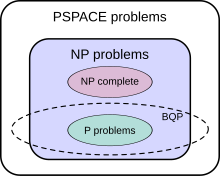
The suspected relationship of BQP to several classical complication classes.[25]
The exact human relationship of BQP to P, NP, and PSPACE is not known. Nevertheless, it is known that ; that is, all problems that tin can be efficiently solved by a deterministic classical reckoner can also be efficiently solved by a breakthrough estimator, and all bug that tin be efficiently solved past a breakthrough computer can as well be solved past a deterministic classical calculator with polynomial infinite resources. It is further suspected that BQP is a strict superset of P, meaning at that place are bug that are efficiently solvable by breakthrough computers that are not efficiently solvable by deterministic classical computers. For example, integer factorization and the discrete logarithm problem are known to be in BQP and are suspected to be outside of P. On the human relationship of BQP to NP, little is known beyond the fact that some NP problems that are believed not to exist in P are besides in BQP (integer factorization and the detached logarithm problem are both in NP, for example). It is suspected that ; that is, it is believed that in that location are efficiently checkable issues that are not efficiently solvable by a quantum figurer. Equally a direct consequence of this belief, information technology is as well suspected that BQP is disjoint from the class of NP-complete problems (if an NP-complete problem were in BQP, then it would follow from NP-hardness that all bug in NP are in BQP).[124]


The human relationship of BQP to the basic classical complexity classes tin can be summarized as follows:

It is as well known that BQP is contained in the complexity class (or more than precisely in the associated grade of conclusion issues ),[124] which is a subclass of PSPACE.


Information technology has been speculated that further advances in physics could atomic number 82 to fifty-fifty faster computers. For case, it has been shown that a non-local hidden variable breakthrough computer based on Bohmian Mechanics could implement a search of an Due north-item database in at near steps, a slight speedup over Grover's algorithm, which runs in steps. Note, however, that neither search method would allow breakthrough computers to solve NP-consummate problems in polynomial time.[125] Theories of quantum gravity, such as 1000-theory and loop quantum gravity, may allow fifty-fifty faster computers to be built. Notwithstanding, defining computation in these theories is an open problem due to the trouble of time; that is, within these physical theories at that place is currently no obvious way to depict what it ways for an observer to submit input to a computer at one betoken in time and then receive output at a later point in time.[126] [127]
![{\displaystyle O({\sqrt[{3}]{N}})}](https://wikimedia.org/api/rest_v1/media/math/render/svg/a953364313112d7f3243feb0c59146295a65263d)

See too [edit]
- Chemical estimator
- D-Wave Systems
- DNA computing
- Electronic breakthrough holography
- Intelligence Avant-garde Research Projects Activity
- Kane breakthrough computer
- Listing of emerging technologies
- Listing of quantum processors
- Magic land distillation
- Natural calculating
- Photonic computing
- Post-quantum cryptography
- Quantum algorithm
- Breakthrough annealing
- Breakthrough passenger vehicle
- Quantum noesis
- Quantum excursion
- Quantum complexity theory
- Quantum cryptography
- Quantum logic gate
- Quantum motorcar learning
- Breakthrough supremacy
- Breakthrough threshold theorem
- Quantum book
- Rigetti Computing
- Supercomputer
- Superposition
- Theoretical computer science
- Timeline of quantum computing
- Topological quantum estimator
- Valleytronics
References [edit]
- ^ a b The National Academies of Sciences, Engineering, and Medicine (2019). Grumbling, Emily; Horowitz, Marking (eds.). Quantum Calculating : Progress and Prospects (2018). Washington, DC: National Academies Press. p. I-5. doi:10.17226/25196. ISBN978-0-309-47969-1. OCLC 1081001288. S2CID 125635007.
{{cite volume}}: CS1 maint: multiple names: authors listing (link) - ^ Aaronson, Scott (eight June 2021). "What Makes Breakthrough Computing So Hard to Explain?". Quanta Magazine . Retrieved 9 November 2021.
- ^ Franklin, Diana; Chong, Frederic T. (2004). "Challenges in Reliable Quantum Computing". Nano, Quantum and Molecular Computing. pp. 247–266. doi:10.1007/one-4020-8068-9_8. ISBN1-4020-8067-0.
- ^ Pakkin, Scott; Coles, Patrick (10 June 2019). "The Problem with Quantum Computers". Scientific American.
- ^ "Quantum calculating apply cases are getting existent—what y'all demand to know". McKinsey & Company. McKinsey & Company. 14 December 2021. Retrieved 1 April 2022.
- ^ a b Nielsen, p. 29
- ^ Benioff, Paul (1980). "The computer as a physical organisation: A microscopic quantum mechanical Hamiltonian model of computers as represented by Turing machines". Periodical of Statistical Physics. 22 (five): 563–591. Bibcode:1980JSP....22..563B. doi:10.1007/bf01011339. S2CID 122949592.
- ^ Feynman, Richard (June 1982). "Simulating Physics with Computers" (PDF). International Journal of Theoretical Physics. 21 (6/7): 467–488. Bibcode:1982IJTP...21..467F. doi:10.1007/BF02650179. S2CID 124545445. Archived from the original (PDF) on 8 January 2019. Retrieved 28 February 2019.
- ^ Manin, Yu. I. (1980). Vychislimoe i nevychislimoe [Computable and Noncomputable] (in Russian). Sov.Radio. pp. 13–15. Archived from the original on x May 2013. Retrieved 4 March 2013.
- ^ Feynman, Richard P. (1986). "Quantum mechanical computers". Foundations of Physics. Springer Scientific discipline and Business Media LLC. sixteen (6): 507–531. Bibcode:1986FoPh...16..507F. doi:10.1007/bf01886518. ISSN 0015-9018. S2CID 122076550.
- ^ Mermin, David (28 March 2006). "Breaking RSA Encryption with a Breakthrough Estimator: Shor'southward Factoring Algorithm" (PDF). Physics 481-681 Lecture Notes. Cornell University. Archived from the original (PDF) on fifteen November 2012.
- ^ Chuang, Isaac L.; Gershenfeld, Neil; Kubinec, Markdoi (April 1998). "Experimental Implementation of Fast Breakthrough Searching". Phys. Rev. Lett. American Concrete Society. 80 (15): 3408–3411. Bibcode:1998PhRvL..fourscore.3408C. doi:x.1103/PhysRevLett.80.3408.
- ^ "quantum figurer". Encyclopædia Britannica. Retrieved four Dec 2021.
- ^ Preskill, John (2018). "Quantum Calculating in the NISQ era and beyond". Quantum. 2: 79. arXiv:1801.00862. doi:ten.22331/q-2018-08-06-79. S2CID 44098998.
- ^ Gibney, Elizabeth (2 Oct 2019). "Breakthrough gold blitz: the private funding pouring into breakthrough outset-ups". Nature. 574 (7776): 22–24. Bibcode:2019Natur.574...22G. doi:x.1038/d41586-019-02935-4. PMID 31578480.
- ^ Rodrigo, Chris Mills (12 February 2020). "Trump budget proposal boosts funding for artificial intelligence, quantum computing". The Hill.
- ^ Gibney, Elizabeth (23 October 2019). "Hullo quantum globe! Google publishes landmark quantum supremacy claim". Nature. 574 (7779): 461–462. Bibcode:2019Natur.574..461G. doi:x.1038/d41586-019-03213-z. PMID 31645740.
- ^ Aaronson, Scott (30 October 2019). "Stance | Why Google'southward Quantum Supremacy Milestone Matters". The New York Times. ISSN 0362-4331. Retrieved 25 September 2021.
- ^ "On 'Quantum Supremacy'". IBM Research Web log. 22 October 2019. Retrieved 9 February 2021.
- ^ Pan, Feng; Zhang, Pan (4 March 2021). "Simulating the Sycamore quantum supremacy circuits". arXiv:2103.03074 [quant-ph].
- ^ Nielsen, Michael A.; Chuang, Isaac Fifty. (2010). Quantum Computation and Breakthrough Information: 10th Anniversary Edition. Cambridge: Cambridge Academy Printing. doi:10.1017/cbo9780511976667. ISBN9780511976667.
- ^ Yanofsky, Noson South.; Mannucci, Mirco (2013). Breakthrough computing for computer scientists. Cambridge University Press. pp. 144–147, 158–169. ISBN978-0-521-87996-5.
- ^ a b c Quantum Algorithm Zoo Archived 29 April 2018 at the Wayback Machine – Stephen Hashemite kingdom of jordan's Homepage
- ^ Schiller, Jon (nineteen June 2009). Breakthrough Computers. ISBN9781439243497.
- ^ a b Nielsen, p. 42
- ^ Nielsen, p. vii
- ^ Brassard, Gilles; Høyer, Peter; Tapp, Alain (2016), "Quantum Algorithm for the Collision Problem", in Kao, Ming-Yang (ed.), Encyclopedia of Algorithms, New York, NY: Springer, pp. 1662–1664, arXiv:quant-ph/9705002, doi:ten.1007/978-1-4939-2864-4_304, ISBN978-1-4939-2864-4 , retrieved six Dec 2020
- ^ Farhi, Edward; Goldstone, Jeffrey; Gutmann, Sam (23 December 2008). "A Breakthrough Algorithm for the Hamiltonian NAND Tree". Theory of Calculating. four (1): 169–190. doi:10.4086/toc.2008.v004a008. ISSN 1557-2862. S2CID 8258191.
- ^ Lenstra, Arjen Thou. (2000). "Integer Factoring" (PDF). Designs, Codes and Cryptography. 19 (two/3): 101–128. doi:ten.1023/A:1008397921377. S2CID 9816153. Archived from the original (PDF) on 10 April 2015.
- ^ a b Bernstein, Daniel J. (2009). "Introduction to post-quantum cryptography". Post-Breakthrough Cryptography. Nature. Vol. 549. pp. i–14. doi:10.1007/978-3-540-88702-7_1. ISBN978-3-540-88701-0. PMID 28905891.
- ^ Meet also pqcrypto.org, a bibliography maintained by Daniel J. Bernstein and Tanja Lange on cryptography not known to be broken past quantum calculating.
- ^ McEliece, R. J. (January 1978). "A Public-Key Cryptosystem Based On Algebraic Coding Theory" (PDF). DSNPR. 44: 114–116. Bibcode:1978DSNPR..44..114M.
- ^ Kobayashi, H.; Gall, F.L. (2006). "Dihedral Hidden Subgroup Problem: A Survey". Information and Media Technologies. i (1): 178–185. doi:10.2197/ipsjdc.one.470.
- ^ Bennett, Charles H.; Bernstein, Ethan; Brassard, Gilles; Vazirani, Umesh (Oct 1997). "Strengths and Weaknesses of Quantum Computing". SIAM Journal on Computing. 26 (5): 1510–1523. arXiv:quant-ph/9701001. Bibcode:1997quant.ph..1001B. doi:ten.1137/s0097539796300933. S2CID 13403194.
- ^ Katwala, Amit (5 March 2020). "Quantum computers will alter the world (if they work)". Wired UK.
- ^ Colin P. Williams (2011). Explorations in Breakthrough Computing. Springer. pp. 242–244. ISBN978-i-84628-887-6.
- ^ Grover, Lov (29 May 1996). "A fast quantum mechanical algorithm for database search". arXiv:quant-ph/9605043.
- ^ Ambainis, Ambainis (June 2004). "Quantum search algorithms". ACM SIGACT News. 35 (2): 22–35. arXiv:quant-ph/0504012. Bibcode:2005quant.ph..4012A. doi:10.1145/992287.992296. S2CID 11326499.
- ^ Rich, Steven; Gellman, Barton (1 Feb 2014). "NSA seeks to build breakthrough reckoner that could crack most types of encryption". The Washington Mail service.
- ^ Norton, Quinn (fifteen February 2007). "The Father of Breakthrough Computing". Wired.
- ^ Ambainis, Andris (Leap 2014). "What Can We Do with a Quantum Reckoner?". Found for Advanced Study.
- ^ "Lunch & Learn: Quantum Computing". Sibos TV. 21 November 2018. Archived from the original on 11 December 2021. Retrieved 4 February 2021 – via YouTube.
- ^ Biamonte, Jacob; Wittek, Peter; Pancotti, Nicola; Rebentrost, Patrick; Wiebe, Nathan; Lloyd, Seth (September 2017). "Breakthrough auto learning". Nature. 549 (7671): 195–202. arXiv:1611.09347. Bibcode:2017Natur.549..195B. doi:10.1038/nature23474. ISSN 0028-0836. PMID 28905917. S2CID 64536201.
- ^ a b Preskill, John (half-dozen Baronial 2018). "Quantum Calculating in the NISQ era and beyond". Quantum. 2: 79. doi:10.22331/q-2018-08-06-79. S2CID 44098998.
- ^ Harrow, Aram; Hassidim, Avinatan; Lloyd, Seth (2009). "Quantum algorithm for solving linear systems of equations". Physical Review Letters. 103 (fifteen): 150502. arXiv:0811.3171. Bibcode:2009PhRvL.103o0502H. doi:10.1103/PhysRevLett.103.150502. PMID 19905613. S2CID 5187993.
- ^ Benedetti, Marcello; Realpe-Gómez, John; Biswas, Rupak; Perdomo-Ortiz, Alejandro (ix August 2016). "Estimation of effective temperatures in quantum annealers for sampling applications: A case written report with possible applications in deep learning". Physical Review A. 94 (2): 022308. arXiv:1510.07611. Bibcode:2016PhRvA..94b2308B. doi:10.1103/PhysRevA.94.022308.
- ^ Ajagekar, Akshay; You, Fengqi (5 December 2020). "Breakthrough computing assisted deep learning for mistake detection and diagnosis in industrial process systems". Computers & Chemical Engineering science. 143: 107119. arXiv:2003.00264. doi:10.1016/j.compchemeng.2020.107119. ISSN 0098-1354. S2CID 211678230.
- ^ Ajagekar, Akshay; You, Fengqi (1 Dec 2021). "Breakthrough computing based hybrid deep learning for mistake diagnosis in electrical power systems". Practical Energy. 303: 117628. doi:10.1016/j.apenergy.2021.117628. ISSN 0306-2619.
- ^ Outeiral, Carlos; Strahm, Martin; Morris, Garrett; Benjamin, Simon; Deane, Charlotte; Shi, Jiye (2021). "The prospects of quantum computing in computational molecular biology". WIREs Computational Molecular Science. eleven. arXiv:2005.12792. doi:x.1002/wcms.1481. S2CID 218889377.
- ^ Lloyd, Due south. (23 Baronial 1996). "Universal Quantum Simulators". Scientific discipline. 273 (5278): 1073–1078. Bibcode:1996Sci...273.1073L. doi:10.1126/science.273.5278.1073. PMID 8688088. S2CID 43496899.
- ^ Gao, Xun; Anschuetz, Eric R.; Wang, Sheng-Tao; Cirac, J. Ignacio; Lukin, Mikhail D. (20 January 2021). "Enhancing Generative Models via Quantum Correlations". arXiv:2101.08354 [quant-ph].
- ^ Li, Junde; Topaloglu, Rasit; Ghosh, Swaroop (9 January 2021). "Quantum Generative Models for Small Molecule Drug Discovery". arXiv:2101.03438 [cs.ET].
- ^ Gircha, A. I.; Boev, A. S.; Avchaciov, K.; Fedichev, P. O.; Fedorov, A. One thousand. (26 August 2021). "Training a discrete variational autoencoder for generative chemistry and drug design on a quantum annealer". arXiv:2108.11644 [quant-ph].
- ^ Dyakonov, Mikhail (15 November 2018). "The Case Against Quantum Computing". IEEE Spectrum.
- ^ DiVincenzo, David P. (13 April 2000). "The Physical Implementation of Quantum Computation". Fortschritte der Physik. 48 (9–11): 771–783. arXiv:quant-ph/0002077. Bibcode:2000ForPh..48..771D. doi:ten.1002/1521-3978(200009)48:9/11<771::Aid-PROP771>3.0.CO;two-Eastward.
- ^ Giles, Martin (17 January 2019). "We'd have more quantum computers if information technology weren't then difficult to find the damn cables". MIT Applied science Review.
- ^ South. J. Pauka, 1000. Das, R. Kalra, A. Moini, Y. Yang, Grand. Trainer, A. Bousquet, C. Cantaloube, N. Dick, G. C. Gardner, M. J. (2021). "A cryogenic CMOS fleck for generating control signals for multiple qubits". Nature Electronics. four (iv): 64–70. arXiv:1912.01299. doi:10.1038/s41928-020-00528-y. S2CID 231715555.
{{cite periodical}}: CS1 maint: uses authors parameter (link) - ^ DiVincenzo, David P. (1995). "Quantum Ciphering". Science. 270 (5234): 255–261. Bibcode:1995Sci...270..255D. CiteSeerX10.1.1.242.2165. doi:10.1126/science.270.5234.255. S2CID 220110562. (subscription required)
- ^ Zu, H.; Dai, W.; de Waele, A.T.A.M. (2022). "Development of Dilution refrigerators – A review". Cryogenics. 121. Bibcode:2022Cryo..121....1Z. doi:10.1016/j.cryogenics.2021.103390. ISSN 0011-2275. S2CID 244005391.
- ^ Jones, Nicola (xix June 2013). "Computing: The quantum visitor". Nature. 498 (7454): 286–288. Bibcode:2013Natur.498..286J. doi:10.1038/498286a. PMID 23783610.
- ^ Vepsäläinen, Antti P.; Karamlou, Amir H.; Orrell, John L.; Dogra, Akshunna S.; Loer, Ben; et al. (August 2020). "Impact of ionizing radiation on superconducting qubit coherence". Nature. 584 (7822): 551–556. arXiv:2001.09190. Bibcode:2020Natur.584..551V. doi:x.1038/s41586-020-2619-8. ISSN 1476-4687. PMID 32848227. S2CID 210920566.
- ^ Amy, Matthew; Matteo, Olivia; Gheorghiu, Vlad; Mosca, Michele; Parent, Alex; Schanck, John (30 November 2016). "Estimating the price of generic breakthrough pre-image attacks on SHA-ii and SHA-3". arXiv:1603.09383 [quant-ph].
- ^ Dyakonov, Yard. I. (14 October 2006). S. Luryi; J. Xu; A. Zaslavsky (eds.). "Is Fault-Tolerant Quantum Ciphering Actually Possible?". Future Trends in Microsystem electronics. Up the Nano Creek: 4–eighteen. arXiv:quant-ph/0610117. Bibcode:2006quant.ph.10117D.
- ^ Freedman, Michael H.; Kitaev, Alexei; Larsen, Michael J.; Wang, Zhenghan (2003). "Topological quantum computation". Bulletin of the American Mathematical Order. 40 (1): 31–38. arXiv:quant-ph/0101025. doi:10.1090/S0273-0979-02-00964-three. MR 1943131.
- ^ Monroe, Don (1 October 2008). "Anyons: The quantum quantum computing needs?". New Scientist.
- ^ Preskill, John (26 March 2012). "Quantum computing and the entanglement frontier". arXiv:1203.5813 [quant-ph].
- ^ Preskill, John (six August 2018). "Breakthrough Computing in the NISQ era and beyond". Quantum. 2: 79. doi:10.22331/q-2018-08-06-79.
- ^ Boixo, Sergio; Isakov, Sergei Five.; Smelyanskiy, Vadim N.; Babbush, Ryan; Ding, Nan; Jiang, Zhang; Bremner, Michael J.; Martinis, John Thousand.; Neven, Hartmut (2018). "Characterizing Quantum Supremacy in Nigh-Term Devices". Nature Physics. xiv (six): 595–600. arXiv:1608.00263. Bibcode:2018NatPh..14..595B. doi:10.1038/s41567-018-0124-x. S2CID 4167494.
- ^ Cruel, Neil (5 July 2017). "Quantum Computers Compete for "Supremacy"". Scientific American.
- ^ Arute, Frank; Arya, Kunal; Babbush, Ryan; Bacon, Dave; Bardin, Joseph C.; Barends, Rami; Biswas, Rupak; Boixo, Sergio; Brandao, Fernando G. Due south. 50.; Buell, David A.; Burkett, Brian; Chen, Yu; Chen, Zijun; Chiaro, Ben; Collins, Roberto; Courtney, William; Dunsworsth, Andrew; Farhi, Edward; Foxen, Brooks; Fowler, Austin; Gidney, Craig; Giustina, Marissa; Graff, Rob; Guerin, Keith; Habegger, Steve; Harrigan, Matthew P.; Hartmann, Michael J.; Ho, Alan; Hoffman, Markus; Huang, Trent; Apprehensive, Travis S.; Isakov, Sergei V.; Jeffery, Evan; Jiang, Zhang; Kafri, Dvir; Kechedzhi, Kostyantyn; Kelly, Julian; Klimov, Paul 5.; Knysh, Sergey; Korotov, Alexander; Kostritsa, Fedor; Landhuis, David; Lindmark, Mike; Lucero, Erik; Lyakh, Dmitry; Mandrà, Salvatore; McClean, Jarrod R.; McEwen, Matthew; Megrant, Anthony; Mi, Xiao; Michielsen, Kristel; Mohseni, Masoud; Mutus, Josh; Naaman, Ofer; Neeley, Matthew; Neill, Charles; Niu, Tater Yuezhen; Ostby, Eric; Petukhov, Andre; Platt, John C.; Quintana, Chris; Rieffel, Eleanor G.; Roushan, Pedram; Rubin, Nicholas C.; Sank, Daniel; Satzinger, Kevin J.; Smelyanskiy, Vadim; Sung, Kevin J.; Trevithick, Matthew D.; Vainsencher, Amit; Villalonga, Benjamin; White, Theodore; Yao, Z. Jamie; Yeh, Ping; Zalcman, Adam; Neven, Hartmut; Martinis, John M. (23 October 2019). "Quantum supremacy using a programmable superconducting processor". Nature. 574 (7779): 505–510. arXiv:1910.11333. Bibcode:2019Natur.574..505A. doi:ten.1038/s41586-019-1666-five. PMID 31645734. S2CID 204836822.
- ^ "Google researchers take reportedly achieved 'quantum supremacy'". MIT Technology Review.
- ^ Tavares, Frank (23 Oct 2019). "Google and NASA Achieve Quantum Supremacy". NASA . Retrieved 16 Nov 2021.
- ^ Pednault, Edwin; Gunnels, John A.; Nannicini, Giacomo; Horesh, Lior; Wisnieff, Robert (22 Oct 2019). "Leveraging Secondary Storage to Simulate Deep 54-qubit Sycamore Circuits". arXiv:1910.09534 [quant-ph].
- ^ Cho, Adrian (23 October 2019). "IBM casts doubt on Google'due south claims of quantum supremacy". Science. doi:x.1126/scientific discipline.aaz6080. ISSN 0036-8075. S2CID 211982610.
- ^ Liu, Yong (Alexander); Liu, Xin (Lucy); Li, Fang (Nancy); Fu, Haohuan; Yang, Yuling; Vocal, Jiawei; Zhao, Pengpeng; Wang, Zhen; Peng, Dajia; Chen, Huarong; Guo, Chu (14 November 2021). "Closing the "quantum supremacy" gap: achieving existent-time simulation of a random quantum circuit using a new Sunway supercomputer". Proceedings of the International Conference for Loftier Functioning Calculating, Networking, Storage and Analysis. SC '21. New York, NY, USA: Association for Computing Machinery: 1–12. arXiv:2110.14502. doi:ten.1145/3458817.3487399. ISBN978-1-4503-8442-1. S2CID 239036985.
- ^ Pan, Feng; Chen, Keyang; Zhang, Pan (4 Nov 2021). "Solving the sampling problem of the Sycamore quantum supremacy circuits". arXiv:2111.03011 [quant-ph].
- ^ Ball, Philip (3 December 2020). "Physicists in China challenge Google's 'quantum advantage'". Nature. 588 (7838): 380. Bibcode:2020Natur.588..380B. doi:10.1038/d41586-020-03434-7. PMID 33273711.
- ^ Garisto, Daniel. "Lite-based Quantum Computer Exceeds Fastest Classical Supercomputers". Scientific American . Retrieved 7 Dec 2020.
- ^ Conover, Emily (3 Dec 2020). "The new lite-based quantum figurer Jiuzhang has achieved breakthrough supremacy". Science News . Retrieved vii December 2020.
- ^ Zhong, Han-Sen; Wang, Hui; Deng, Yu-Hao; Chen, Ming-Cheng; Peng, Li-Chao; Luo, Yi-Han; Qin, Jian; Wu, Dian; Ding, Xing; Hu, Yi; Hu, Peng (3 Dec 2020). "Quantum computational reward using photons". Science. 370 (6523): 1460–1463. arXiv:2012.01625. Bibcode:2020Sci...370.1460Z. doi:10.1126/science.abe8770. ISSN 0036-8075. PMID 33273064. S2CID 227254333.
- ^ "IBM's Hawkeye -- 127-Qubit Quantum Processor -- Takes Flight". The Quantum Daily. 15 Nov 2021. Retrieved 18 November 2021.
- ^ Unruh, Bill (1995). "Maintaining coherence in Quantum Computers". Concrete Review A. 51 (2): 992–997. arXiv:hep-th/9406058. Bibcode:1995PhRvA..51..992U. doi:10.1103/PhysRevA.51.992. PMID 9911677. S2CID 13980886.
- ^ Davies, Paul. "The implications of a holographic universe for quantum computer science and the nature of physical law" (PDF). Macquarie University.
- ^ "Quantum Supremacy and Complication". 23 April 2016.
- ^ Kalai, Gil. "The Quantum Calculator Puzzle" (PDF). AMS.
- ^ Rinott, Yosef; Shoham, Tomer; Kalai, Gil (13 July 2021). "Statistical Aspects of the Quantum Supremacy Sit-in". arXiv:2008.05177 [quant-ph].
- ^ Dyakonov, Mikhail (15 November 2018). "The Instance Confronting Quantum Calculating". IEEE Spectrum . Retrieved 3 December 2019.
- ^ Dyakonov, Mikhail (24 March 2020). Will We Ever Have a Quantum Computer?. Springer. ISBN9783030420185 . Retrieved 22 May 2020. [ folio needed ]
- ^ Clarke, John; Wilhelm, Frank G. (18 June 2008). "Superconducting breakthrough bits". Nature. 453 (7198): 1031–1042. Bibcode:2008Natur.453.1031C. doi:x.1038/nature07128. PMID 18563154. S2CID 125213662.
- ^ Kaminsky, William Yard.; Lloyd, Seth; Orlando, Terry P. (12 March 2004). "Scalable Superconducting Architecture for Adiabatic Quantum Ciphering". arXiv:quant-ph/0403090. Bibcode:2004quant.ph..3090K.
- ^ Khazali, Mohammadsadegh; Mølmer, Klaus (eleven June 2020). "Fast Multiqubit Gates by Adiabatic Evolution in Interacting Excited-State Manifolds of Rydberg Atoms and Superconducting Circuits". Physical Review 10. 10 (2): 021054. Bibcode:2020PhRvX..10b1054K. doi:10.1103/PhysRevX.10.021054.
- ^ Henriet, Loic; Beguin, Lucas; Signoles, Adrien; Lahaye, Thierry; Browaeys, Antoine; Reymond, Georges-Olivier; Jurczak, Christophe (22 June 2020). "Quantum computing with neutral atoms". Quantum. four: 327. arXiv:2006.12326. doi:10.22331/q-2020-09-21-327. S2CID 219966169.
- ^ Imamog¯lu, A.; Awschalom, D. D.; Burkard, G.; DiVincenzo, D. P.; Loss, D.; Sherwin, Grand.; Small, A. (fifteen Nov 1999). "Quantum Data Processing Using Quantum Dot Spins and Cavity QED". Physical Review Letters. 83 (20): 4204–4207. arXiv:quant-ph/9904096. Bibcode:1999PhRvL..83.4204I. doi:10.1103/PhysRevLett.83.4204. S2CID 18324734.
- ^ Fedichkin, 50.; Yanchenko, K.; Valiev, K. A. (June 2000). "Novel coherent quantum scrap using spatial quantization levels in semiconductor quantum dot". Quantum Computers and Computing. 1: 58. arXiv:quant-ph/0006097. Bibcode:2000quant.ph..6097F.
- ^ Ivády, Viktor; Davidsson, Joel; Delegan, Nazar; Falk, Abram L.; Klimov, Paul 5.; Whiteley, Samuel J.; Hruszkewycz, Stephan O.; Holt, Martin V.; Heremans, F. Joseph; Son, Nguyen Tien; Awschalom, David D.; Abrikosov, Igor A.; Gali, Adam (6 Dec 2019). "Stabilization of bespeak-defect spin qubits past breakthrough wells". Nature Communications. 10 (i): 5607. arXiv:1905.11801. Bibcode:2019NatCo..x.5607I. doi:x.1038/s41467-019-13495-half dozen. PMC6898666. PMID 31811137.
- ^ "Scientists Detect New Way to Get Quantum Computing to Work at Room Temperature". interestingengineering.com. 24 April 2020.
- ^ Bertoni, A.; Bordone, P.; Brunetti, R.; Jacoboni, C.; Reggiani, S. (19 June 2000). "Breakthrough Logic Gates based on Coherent Electron Transport in Breakthrough Wires". Physical Review Letters. 84 (25): 5912–5915. Bibcode:2000PhRvL..84.5912B. doi:10.1103/PhysRevLett.84.5912. hdl:11380/303796. PMID 10991086.
- ^ Ionicioiu, Radu; Amaratunga, Gehan; Udrea, Florin (20 January 2001). "Quantum Ciphering with Ballistic Electrons". International Journal of Modern Physics B. 15 (2): 125–133. arXiv:quant-ph/0011051. Bibcode:2001IJMPB..15..125I. CiteSeerX10.1.ane.251.9617. doi:x.1142/S0217979201003521. S2CID 119389613.
- ^ Ramamoorthy, A; Bird, J P; Reno, J 50 (xi July 2007). "Using split-gate structures to explore the implementation of a coupled-electron-waveguide qubit scheme". Journal of Physics: Condensed Matter. 19 (27): 276205. Bibcode:2007JPCM...19A6205R. doi:ten.1088/0953-8984/19/27/276205.
- ^ Eduardo Berrios; Martin Gruebele; Dmytro Shyshlov; Lei Wang; Dmitri Babikov (2012). "Loftier fidelity quantum gates with vibrational qubits". Journal of Chemic Physics. 116 (46): 11347–11354. Bibcode:2012JPCA..11611347B. doi:10.1021/jp3055729. PMID 22803619.
- ^ Leuenberger, Michael N.; Loss, Daniel (April 2001). "Quantum calculating in molecular magnets". Nature. 410 (6830): 789–793. arXiv:cond-mat/0011415. Bibcode:2001Natur.410..789L. doi:10.1038/35071024. PMID 11298441. S2CID 4373008.
- ^ Harneit, Wolfgang (27 February 2002). "Fullerene-based electron-spin quantum computer". Physical Review A. 65 (3): 032322. Bibcode:2002PhRvA..65c2322H. doi:10.1103/PhysRevA.65.032322.
- ^ Igeta, Yard.; Yamamoto, Y. (1988). Quantum mechanical computers with single atom and photon fields. International Quantum Electronics Conference.
- ^ Chuang, I.L.; Yamamoto, Y. (1995). "Uncomplicated quantum reckoner". Physical Review A. 52 (5): 3489–3496. arXiv:quant-ph/9505011. Bibcode:1995PhRvA..52.3489C. doi:10.1103/PhysRevA.52.3489. PMID 9912648. S2CID 30735516.
- ^ Knill, G. J.; Laflamme, R.; Milburn, G. J. (2001). "A scheme for efficient quantum computation with linear optics". Nature. 409 (6816): 46–52. Bibcode:2001Natur.409...46K. doi:10.1038/35051009. PMID 11343107. S2CID 4362012.
- ^ Nizovtsev, A. P. (August 2005). "A quantum calculator based on NV centers in diamond: Optically detected nutations of unmarried electron and nuclear spins". Optics and Spectroscopy. 99 (two): 248–260. Bibcode:2005OptSp..99..233N. doi:10.1134/1.2034610. S2CID 122596827.
- ^ Dutt, Yard. V. M.; Childress, L.; Jiang, Fifty.; Togan, E.; Maze, J.; Jelezko, F.; Zibrov, A. S.; Hemmer, P. R.; Lukin, M. D. (1 June 2007). "Breakthrough Register Based on Individual Electronic and Nuclear Spin Qubits in Diamond". Science. 316 (5829): 1312–1316. Bibcode:2007Sci...316.....D. doi:10.1126/science.1139831. PMID 17540898. S2CID 20697722.
- ^ David Baron (7 June 2007). "At room temperature, carbon-13 nuclei in diamond create stable, controllable breakthrough register". The Harvard Gazette, FAS Communications.
- ^ Neumann, P.; et al. (6 June 2008). "Multipartite Entanglement Among Single Spins in Diamond". Scientific discipline. 320 (5881): 1326–1329. Bibcode:2008Sci...320.1326N. doi:10.1126/science.1157233. PMID 18535240. S2CID 8892596.
- ^ Anderlini, Marco; Lee, Patricia J.; Brown, Benjamin L.; Sebby-Strabley, Jennifer; Phillips, William D.; Porto, J. V. (July 2007). "Controlled commutation interaction betwixt pairs of neutral atoms in an optical lattice". Nature. 448 (7152): 452–456. arXiv:0708.2073. Bibcode:2007Natur.448..452A. doi:10.1038/nature06011. PMID 17653187. S2CID 4410355.
- ^ "Thousands of Atoms Swap 'Spins' with Partners in Quantum Square Trip the light fantastic". NIST. 8 Jan 2018.
- ^ Ohlsson, N.; Mohan, R. Chiliad.; Kröll, Southward. (1 January 2002). "Quantum reckoner hardware based on rare-globe-ion-doped inorganic crystals". Opt. Commun. 201 (1–3): 71–77. Bibcode:2002OptCo.201...71O. doi:10.1016/S0030-4018(01)01666-2.
- ^ Longdell, J. J.; Sellars, M. J.; Manson, N. B. (23 September 2004). "Demonstration of conditional breakthrough stage shift betwixt ions in a solid". Phys. Rev. Lett. 93 (13): 130503. arXiv:quant-ph/0404083. Bibcode:2004PhRvL..93m0503L. doi:10.1103/PhysRevLett.93.130503. PMID 15524694. S2CID 41374015.
- ^ Náfrádi, Bálint; Choucair, Mohammad; Dinse, Klaus-Peter; Forró, László (18 July 2016). "Room temperature manipulation of long lifetime spins in metallic-like carbon nanospheres". Nature Communications. 7 (1): 12232. arXiv:1611.07690. Bibcode:2016NatCo...712232N. doi:ten.1038/ncomms12232. PMC4960311. PMID 27426851.
- ^ Das, A.; Chakrabarti, B. K. (2008). "Quantum Annealing and Analog Quantum Computation". Rev. Mod. Phys. lxxx (3): 1061–1081. arXiv:0801.2193. Bibcode:2008RvMP...eighty.1061D. CiteSeerXx.1.1.563.9990. doi:10.1103/RevModPhys.80.1061. S2CID 14255125.
- ^ Nayak, Chetan; Simon, Steven; Stern, Ady; Das Sarma, Sankar (2008). "Nonabelian Anyons and Breakthrough Computation". Reviews of Modern Physics. 80 (iii): 1083–1159. arXiv:0707.1889. Bibcode:2008RvMP...80.1083N. doi:10.1103/RevModPhys.80.1083. S2CID 119628297.
- ^ Chi-Chih Yao, A. (1993). "Quantum circuit complexity". Proceedings of 1993 IEEE 34th Annual Foundations of Computer Science: 352–361. doi:10.1109/SFCS.1993.366852. ISBN0-8186-4370-6. S2CID 195866146.
- ^ Raussendorf, Robert; Browne, Daniel Due east.; Briegel, Hans J. (25 August 2003). "Measurement-based quantum computation on cluster states". Concrete Review A. 68 (2): 022312. arXiv:quant-ph/0301052. Bibcode:2003PhRvA..68b2312R. doi:10.1103/PhysRevA.68.022312. S2CID 6197709.
- ^ Aharonov, Dorit; van Dam, Wim; Kempe, Julia; Landau, Zeph; Lloyd, Seth; Regev, Oded (ane January 2008). "Adiabatic Quantum Computation Is Equivalent to Standard Quantum Computation". SIAM Review. fifty (4): 755–787. arXiv:quant-ph/0405098. Bibcode:2008SIAMR..50..755A. doi:10.1137/080734479. ISSN 0036-1445.
- ^ Freedman, Michael H.; Larsen, Michael; Wang, Zhenghan (one June 2002). "A Modular Functor Which is Universal for Breakthrough Computation". Communications in Mathematical Physics. 227 (3): 605–622. arXiv:quant-ph/0001108. Bibcode:2002CMaPh.227..605F. doi:10.1007/s002200200645. ISSN 0010-3616. S2CID 8990600.
- ^ Nielsen, p. 126
- ^ Nielsen, p. 41
- ^ Nielsen, p. 201
- ^ a b Bernstein, Ethan; Vazirani, Umesh (1997). "Breakthrough Complexity Theory". SIAM Journal on Computing. 26 (5): 1411–1473. CiteSeerXx.1.1.144.7852. doi:x.1137/S0097539796300921.
- ^ Aaronson, Scott. "Breakthrough Computing and Hidden Variables" (PDF).
- ^ Aaronson, Scott (2005). "NP-complete Issues and Concrete Reality". ACM SIGACT News. 2005. arXiv:quant-ph/0502072. Bibcode:2005quant.ph..2072A. Encounter department 7 "Breakthrough Gravity": "[…] to anyone who wants a exam or benchmark for a favorite quantum gravity theory,[writer'southward footnote: That is, 1 without all the carp of making numerical predictions and comparing them to observation] allow me humbly propose the following: can you define Quantum Gravity Polynomial-Time? […] until nosotros can say what information technology means for a 'user' to specify an 'input' and 'subsequently' receive an 'output'—at that place is no such affair as computation, not even theoretically." (accent in original)
- ^ "D-Wave Systems sells its get-go Quantum Computing System to Lockheed Martin Corporation". D-Wave. 25 May 2011. Retrieved xxx May 2011.
Farther reading [edit]
Textbooks [edit]
- Nielsen, Michael; Chuang, Isaac (2000). Quantum Ciphering and Quantum Data. Cambridge: Cambridge University Press. ISBN978-0-521-63503-5. OCLC 174527496.
- Mermin, Northward. David (2007). Breakthrough Computer science: An Introduction. Cambridge University Press. ISBN978-0-521-87658-2.
- Akama, Seiki (2014). Elements of Quantum Computing: History, Theories and Engineering Applications. Springer International Publishing. ISBN978-3-319-08284-4.
- Benenti, Giuliano (2004). Principles of Quantum Ciphering and Information Volume ane. New Jersey: Earth Scientific. ISBN978-981-238-830-viii. OCLC 179950736.
- Stolze, Joachim; Suter, Dieter (2004). Quantum Computing. Wiley-VCH. ISBN978-3-527-40438-4.
- Wichert, Andreas (2014). Principles of Quantum Artificial Intelligence. World Scientific Publishing Co. ISBN978-981-4566-74-2.
- Hiroshi, Imai; Masahito, Hayashi (2006). Quantum Computation and Data. Berlin: Springer. ISBN978-three-540-33132-2.
- Jaeger, Gregg (2006). Quantum Information: An Overview. Berlin: Springer. ISBN978-0-387-35725-6. OCLC 255569451.
- Wong, Thomas (2022). Introduction to Classical and Quantum Computing (PDF). Rooted Grove. ISBN979-8985593105.
Academic papers [edit]
- Abbot, Derek; Doering, Charles R.; Caves, Carlton Chiliad.; Lidar, Daniel M.; Brandt, Howard E.; Hamilton, Alexander R.; Ferry, David Grand.; Gea-Banacloche, Julio; Bezrukov, Sergey Grand.; Kish, Laszlo B. (2003). "Dreams versus Reality: Plenary Debate Session on Breakthrough Computing". Quantum Data Processing. 2 (6): 449–472. arXiv:quant-ph/0310130. doi:10.1023/B:QINP.0000042203.24782.9a. hdl:2027.42/45526. S2CID 34885835.
- Berthiaume, Andre (1997). "Quantum Computation".
- DiVincenzo, David P. (2000). "The Physical Implementation of Quantum Computation". Fortschritte der Physik. 48 (ix–11): 771–783. arXiv:quant-ph/0002077. Bibcode:2000ForPh..48..771D. doi:ten.1002/1521-3978(200009)48:ix/11<771::Assistance-PROP771>3.0.CO;2-E.
- DiVincenzo, David P. (1995). "Quantum Ciphering". Scientific discipline. 270 (5234): 255–261. Bibcode:1995Sci...270..255D. CiteSeerXx.1.1.242.2165. doi:x.1126/science.270.5234.255. S2CID 220110562. Tabular array 1 lists switching and dephasing times for diverse systems.
- Feynman, Richard (1982). "Simulating physics with computers". International Journal of Theoretical Physics. 21 (six–7): 467–488. Bibcode:1982IJTP...21..467F. CiteSeerX10.one.i.45.9310. doi:10.1007/BF02650179. S2CID 124545445.
- Jeutner, Valentin (2021). "The Quantum Imperative: Addressing the Legal Dimension of Quantum Computers". Morals & Machines. 1 (ane): 52–59. doi:10.5771/2747-5174-2021-1-52. S2CID 236664155.
- Mitchell, Ian (1998). "Computing Ability into the 21st Century: Moore'south Law and Beyond".
- Simon, Daniel R. (1994). "On the Power of Quantum Computation". Establish of Electrical and Electronics Engineers Calculator Lodge Printing.
External links [edit]
- Stanford Encyclopedia of Philosophy: "Quantum Computing" past Amit Hagar and Michael E. Cuffaro.
- "Quantum computation, theory of", Encyclopedia of Mathematics, EMS Press, 2001 [1994]
- Quantum computing for the very curious by Andy Matuschak and Michael Nielsen
- Quantum Computing Made Piece of cake on Satalia blog
- Lectures
- Quantum computing for the adamant – 22 video lectures by Michael Nielsen
- Video Lectures by David Deutsch
- Lectures at the Institut Henri Poincaré (slides and videos)
- Online lecture on An Introduction to Quantum Computing, Edward Gerjuoy (2008)
- Lomonaco, Sam. Four Lectures on Quantum Computing given at Oxford University in July 2006
Source: https://en.wikipedia.org/wiki/Quantum_computing

Post a Comment for "Quantum Information 2 Volume Set From Foundations to Quantum Technology Applications Book Review"